


Search O Pal
Aug 3, 20260 comments8 minutes read
Small recruitment agencies don't have the recruiter headcount that enterprise talent acquisition teams do, but they often get the same flood of applications per job posting. Industry data from Employ Inc. puts average applications per job at over 250 in 2025, up from roughly 207 the year before — and a two- or three-person agency has to screen every one of them manually unless they automate the first pass.
The short answer: for small agencies specifically, the tools worth evaluating are CV Shortlister, Manatal, Skima AI, CVViZ, Freshteam, JazzHR, and Workable — because each one is priced and built for teams under 20 people, not enterprise talent suites that assume a dedicated recruiting-ops function. Below is how they actually compare on price, setup effort, and where each one falls short.

We looked at seven factors that matter specifically for small agencies, not enterprise buyers: per-CV or per-seat cost (agencies bill clients per role, so cost predictability matters more than feature depth), setup time, accuracy against a real job description rather than keyword matching, whether pricing punishes high application volume, integration effort, and whether the tool requires a long-term contract. Tools built primarily for 200+ person internal TA teams were excluded even if they're well known, because their pricing and workflow assumptions don't fit a small agency's reality.
Tool | Best for | Starting price | Pricing model | Setup time |
CV Shortlister | Agencies screening high CV volume per role | Free tier available, then ~$0.03/CV | Usage-based, no seat minimum | Same day |
Manatal | Agencies wanting a full ATS + screening in one | ~$15/user/month | Per seat, tiered by open jobs | 1–2 days |
Skima AI | Agencies focused purely on resume ranking | ~$49/month | Flat monthly | Same day |
CVViZ | Teams wanting deep candidate-ranking logic | Custom quote | Per seat | 2–3 days |
Freshteam | Agencies wanting to start completely free | Free tier available | Freemium | Same day |
JazzHR | Agencies that also need applicant tracking | ~$75/month | Flat monthly | 1–2 days |
Workable | Agencies planning to scale past 10 recruiters | ~$189/month | Flat monthly, tiered | 2–3 days |
Prices above are entry-tier and change frequently — always confirm current pricing directly with the vendor before budgeting.
Most AI screening tools charge per seat, which punishes small agencies during busy hiring months when volume spikes but headcount doesn't. CV Shortlister instead prices per CV processed, which keeps cost proportional to actual workload instead of team size.
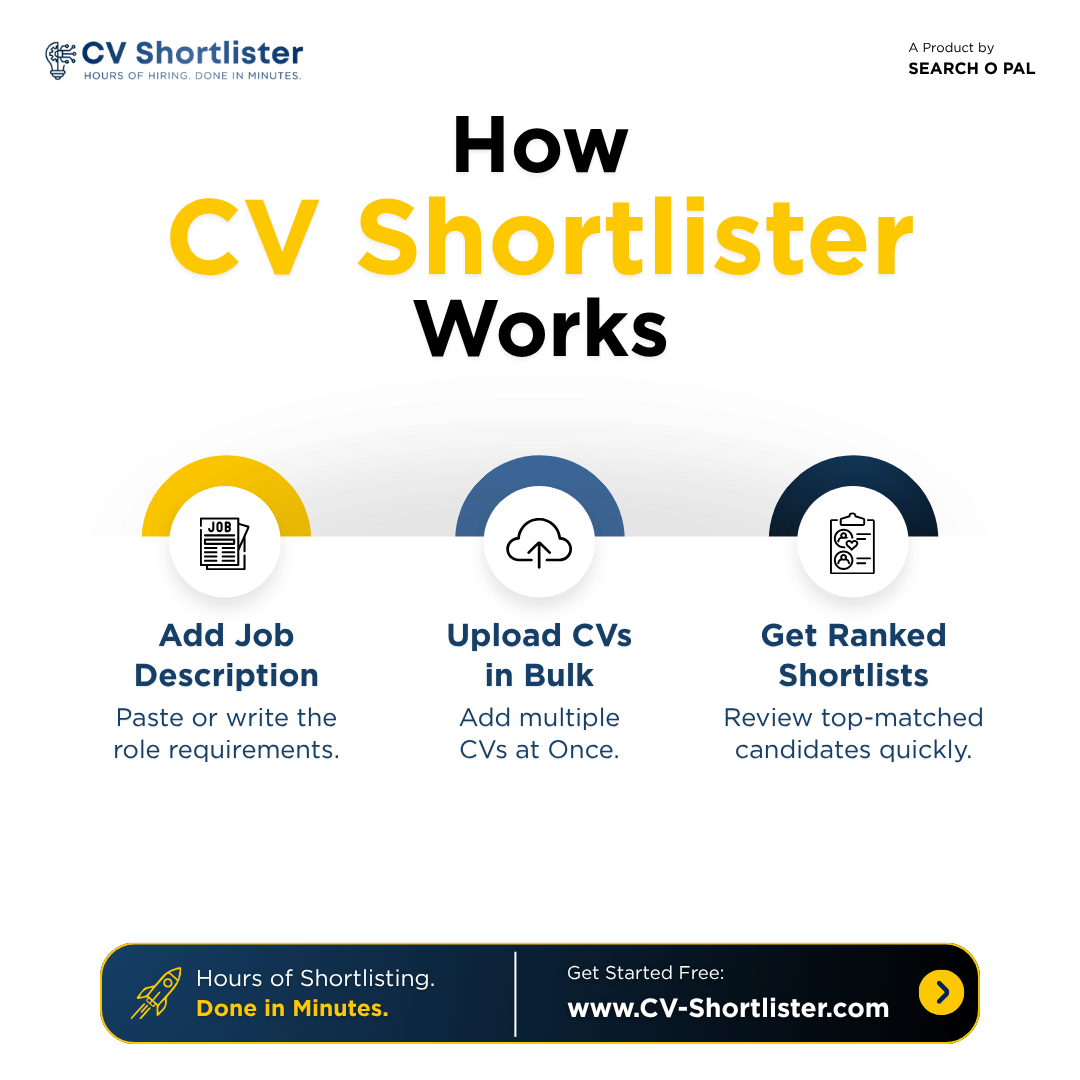
How it works: you upload a job description and a batch of CVs, and it ranks and shortlists candidates against the specific requirements in that JD — rather than generic keyword matching. In practical use, screening that would take a recruiter roughly 8–10 minutes per CV manually comes down to about 20–30 seconds per CV, which is where the reported cost reduction (a documented case showed roughly 95% lower screening cost, saving one agency the equivalent of over 480 recruiter-hours on a single hiring push) comes from.
Manatal is a cloud-based ATS built specifically for small and mid-sized agencies and staffing firms, with AI resume screening added directly into the pipeline. In January 2026 it also added an AI interviewer feature for asynchronous video interviews, which extends it beyond pure resume screening.
Skima AI is built as a focused resume screener rather than a full recruiting suite, which makes it a reasonable fit for an agency that already has a CRM or spreadsheet-based pipeline and just wants the screening step automated.
CVViZ focuses specifically on resume screening and candidate ranking, using context-aware matching rather than pure keyword search — meaning it can account for a candidate's experience being described differently than the exact wording in the job description.
Freshteam offers a genuinely usable free tier with basic screening functionality, which makes it a reasonable starting point for a very early-stage agency or solo recruiter testing whether AI screening is worth paying for at all.
JazzHR combines applicant tracking with AI-assisted screening, aimed at small and mid-sized businesses that want one tool covering both the pipeline and the initial filtering step.
Workable is a more established full recruiting platform that has added AI screening, including a semantic matching engine and an anonymized screening mode that hides candidate names and demographic details during initial evaluation to reduce bias.
Are AI CV screening tools accurate enough to trust for a first pass?
Accuracy varies by tool. Basic keyword-matching tools can miss qualified candidates who describe their experience differently than the job description's exact wording. More advanced tools using semantic or context-aware matching tend to report meaningfully higher accuracy, which is why the matching method matters more than the marketing claim.
Do small agencies really need AI screening, or is it overkill?
If a single job posting regularly gets more than 30–50 applications, manual screening starts eating hours that could go toward client calls and placements instead. Below that volume, it's a convenience rather than a necessity.
What's the difference between per-seat and per-CV pricing?
Per-seat pricing charges a flat amount per recruiter per month regardless of how many CVs you screen. Per-CV (usage-based) pricing charges based on actual volume processed, which tends to suit agencies with inconsistent hiring spikes better than a flat monthly fee.
Can these tools replace a recruiter's judgment entirely?
No credible tool claims full replacement. All of the tools above are positioned as a first-pass filter that narrows a large applicant pool down to a shortlist — the final decision still sits with a human recruiter.
Search O Pal is an AI-powered job portal in Pakistan that connects job seekers with verified employers and helps them find relevant jobs quickly and securely.
Previous Post
Create a job-winning resume in minutes with our AI-powered builder.

Comments
No Comments to read