


Iqra Iqbal
May 18, 20260 comments10 minutes read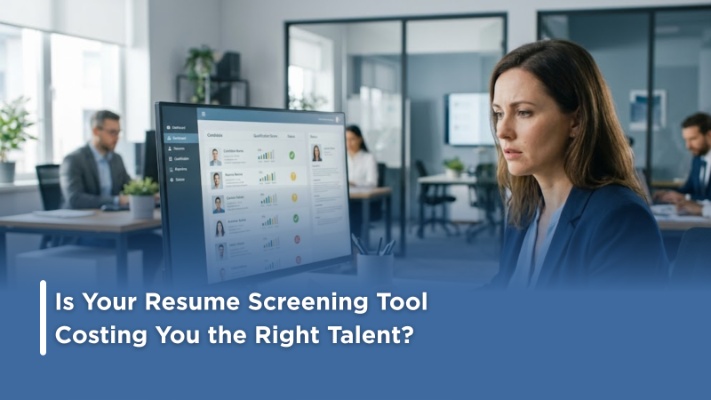
TL;DR: Yes, if your resume screening tool is too rigid or keyword-focused, it can quietly filter out highly qualified candidates. The most effective hiring teams combine automation with human judgment to avoid missing out on real talent.
Let’s get straight to it.
Is Your Resume Screening Tool Costing You the Right Talent? In many cases, absolutely.
Now, to be fair… sometimes things work out. A strong candidate slips through the filters, and you make a great hire. It happens. But relying on that kind of luck isn’t a strategy. Hiring decisions shape the future of your company they can build momentum or quietly hold it back.
Most companies depend on ATS and automated resume filters to handle large volumes of applications. Makes sense. You can’t manually read hundreds (or thousands) of CVs every week.
But here’s the catch… these tools don’t understand talent. They only match patterns.
And sometimes, the best candidates don’t follow patterns.
From the outside, everything seems okay. You post a job, get applications, and run them through your system.
But behind the scenes, it’s doing things like the following:
It’s efficient… but also kind of blind.
A candidate might be perfect for the role just described differently.
And that’s where the problem starts.
Resume tools are built to find the “closest match.” Sounds good, right?
But real hiring doesn’t work like that.
Let’s say your job requires “SEO specialist." A candidate writes “Search Optimization Expert.”
Same thing. Different wording.
Your tool? Might reject them.
This is exactly why people keep asking, "Is Your Resume Screening Tool Costing You the Right Talent?"
Because it doesn’t take much for a great candidate to disappear from your pipeline.
But it gets very interesting – and somewhat uncomfortable – after that…
You’re not just missing random candidates. You’re missing:
Basically… the kind of people companies say they want.
Sometimes the issue isn’t obvious. You’re still getting applicants. Roles are still getting filled.
But look closer.
And that’s when the question hits again,
Is Your Resume Screening Tool Costing You the Right Talent?
Honestly… this is where things start to get a little messy.
Because what looks “perfect” to a machine isn’t always what a human recruiter values—and that gap can quietly cost you great talent.
Hiring Factor | Automated Screening Tool | Human Recruiter |
Keyword Matching | Exact and strict | Flexible and contextual |
Understanding Skills | Limited | Strong |
Career Gaps | Often penalized | Interpreted with context |
Resume Formatting | Can reject non-standard CVs | Usually adaptable |
Speed | Very fast | Slower but thoughtful |
Talent Potential | Often overlooked | Easier to recognize |
There’s a gap here… and it matters more than most teams realize.
Keyword-based filtering made sense years ago. It was simple and scalable.
But now? Jobs have evolved. Skills overlap. Roles are fluid. People describe their work differently.
And yet, many tools still rely on the following:
Which means:
It’s messy. And good candidates fall through the cracks… all the time.
This isn’t just a hiring issue. It affects your entire business. When your system filters out strong candidates, you end up with:
And ironically… more reliance on the same broken system.
To be fair, they’re not useless. Resume screening tools exist because hiring at scale is messy, and companies need speed and structure.
Resume screening tools help with:
Without them, hiring would be chaotic.
But relying on them completely? That’s where things go wrong.
You don’t need to ditch your system. Just make it smarter… more flexible.
Relax keyword strictness
Allow variations and related terms so qualified candidates aren’t missed just because they used different wording or industry phrases on their resumes.
Introduce human checkpoints
Reviewing even 10–20% of rejected resumes can help uncover strong candidates that automated systems might wrongly filter out.
Skills over titles
Different organizations may use different titles, but the skills and experience of the candidates are far more important than the title itself.
ATS filtering audit.
It is important to regularly review why certain candidates were rejected and analyze the reasons behind it.
Test your system with real resumes.
Running actual CVs through your setup helps you quickly identify gaps or unfair filtering rules.
Encourage diverse resume formats
Not every strong candidate follows the same template, so allowing flexibility can help you discover hidden talent.
Small changes… big impact.
Hiring isn’t about choosing between automation and humans, it’s about finding the right balance between both. Here’s the truth:
You need both.
Think of your screening tool as a support system, not a gatekeeper.
Because once it becomes the final decision-maker… you’re no longer hiring people. You’re filtering data.
So Is Your Resume Screening Tool Costing You the Right Talent?
If you've been reading until now, then you already know the answer.
The good news is… You don’t have to stay stuck with outdated hiring methods.
Platforms like Search O Pal are built to solve exactly this problem. Instead of relying on rigid keyword filters, Search O Pal focuses on smarter, skill-based hiring that actually identifies real talent not just “perfect" resumes.
And if you’re specifically looking to improve your screening process, tools like CV Shortlister help you shortlist candidates more intelligently, combining automation with deeper analysis so you don’t miss out on high-potential applicants. Search O Pal also offers a range of hiring and recruitment solutions designed to make your process faster, more accurate, and… honestly, more human.
And in the end, while your first choice might look flawless on paper, the ideal candidate is one who your hiring process would never consider.
I create engaging & informative content around jobs, hiring trends & career development. Through my writing, I aim to help job seekers make smarter career choices & help employers find the right talent in Pakistan.
Previous Post
Create a job-winning resume in minutes with our AI-powered builder.

Comments
No Comments to read