


Iqra Iqbal
Aug 3, 20260 comments15 minutes read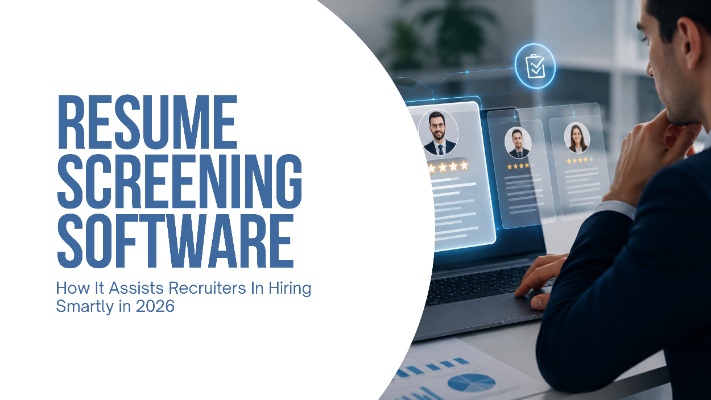
TL;DR: With resume screening software, recruiters are able to screen, compare, and assess several resumes in accordance with the job needs and criteria within a very short period of time. The use of such technology combined with common sense would allow reducing repetitive screening activities.
If your business ends up receiving hundreds of CVs for a single job position, opening every one of them by hand can soon become tedious. Resume screening software helps solve this problem by analyzing applications against predefined hiring criteria and bringing the most relevant candidates to the recruiter’s attention first. Modern tools can go beyond simple keyword matching, using resume parsing, AI candidate scoring, skills matching, and other forms of automation to make the first stage of hiring faster and more organized.
This is particularly relevant today, when it's easy for a talented applicant to get drowned among hundreds of other applications, waiting in a recruiter’s inbox.
Resume screening software, at the most basic level, is simply another name for recruiting technology that allows organizations to process applicants in advance of advancing candidates to the next step. The software scans information from a CV and assesses it against the demands of the job in question. Depending on the system, the following data might be analyzed:
While some recruiting sites merely filter applications, others, such as new AI-driven recruiting systems, can rate candidates based on the selection criteria laid out by the recruitment team.
Thus, instead of having to go through individual resumes during the first couple of hours each day, recruiters will have a better starting point.
The specifics may vary from platform to platform, but the essence of the process is quite simple.
During this phase, the recruitment team gives the job description, along with specifying the requirements in terms of qualifications, skills, experience, and other important criteria. Therefore, in case the firm hires Software Engineers, it may focus on relevant skills, such as Python, Django, REST API, Git, as well as three years of experience.
Resume parser software will extract all useful information from uploaded resumes and organize it into useful candidate information. The software is not just concerned with taking a resume as a file but can actually identify information like skills, education, job experience, and even past job history.
The screening tool compares the candidate’s information against the role criteria. This is where AI-assisted candidate matching and automatic resume evaluation could come in handy. Based on how a particular program is configured, candidates will either be screened out or rated/evaluated, or both.
The goal isn’t necessarily to let software make every hiring decision. But a more intelligent strategy involves deploying technology to handle the time-consuming task of screening and letting recruiters make the final decision. This is necessary since not everything in terms of abilities can be reflected in a resume.
They both have their own roles in recruitment. All in all, it is simply a matter of speed and repetition.
Factor | Manual Screening | Automated Screening |
Resume volume | Difficult with high volume | Designed for large applicant pools |
Screening speed | Slower | Much Faster |
Candidate comparison | Can vary between recruiters | More structured |
Repetitive work | High | Lower |
Candidate ranking | Usually manual | Can be automated |
Human judgment | Strong | Still needed for final decisions |
Scalability | Limited | Easier to scale |
For a small business receiving 20 applications, manual screening may be perfectly manageable. But imagine receiving 700 applications for one position. That’s where automation starts making a real difference.
The biggest advantage of resume screening software is not simply that it “uses AI.” The real benefit is removing repetitive work from the hiring process.
Spending time sifting through CVs would take away valuable time from interviews and conversations with the hiring managers. The automated resume screening will perform many tasks automatically and enable recruiters to focus on the better candidates.
The retail sector, call centers, healthcare, and other businesses will get numerous applications for the same job position. The use of an automated screening program provides recruiters with a solution for handling a large volume of work without having to review each application from scratch.
If all candidates are evaluated on the same predetermined criteria, then it will be easier to compare the applications. This is not to mean that the process will necessarily be a fair one.
The latest research has even emphasized how suggestions from AI tools can affect human decision-making when screening resumes, which is why recruiters should use AI as decision support.
A screening program will assist recruiters in locating the right candidate who has experience and a skill set that matches the position offered.
The screening program will be useful especially when the recruiter has little time to screen and there are many candidates to choose from.
Not all recruiting screening tools work the same way. Before choosing one, look at what it actually does — not just whether the website says “AI-powered.”
Useful features can include:
It’s also worth checking whether the system allows recruiters to customize screening criteria.
A marketing executive and a laboratory technologist obviously shouldn’t be evaluated using the same checklist.
Not always. This is a very significant difference.
The conventional ATS tools use a lot of structure-based information. The AI systems consider the context of the candidate’s skills and experience.
For example, two candidates may describe similar experience using different wording. A purely keyword-based system could struggle to recognize the connection, while a more advanced AI system may understand the relationship.
Still, AI isn’t magic.
A poorly written job description can produce poor screening results. Unclear requirements can also make candidate ranking less useful. Recent research into LLM-based resume screening shows the potential for more context-aware evaluation, but also points to practical issues such as privacy and the quality of evaluation criteria.
Automated screening doesn’t only affect recruiters. Prospective employees have to know that as well. All companies are adopting this automation process; thus, you must make sure your resume shows what you have experienced.
Tips from a recruiting agent:
The goal isn’t to “trick” an ATS. It’s to make your actual qualifications easy for both software and people to understand. Recent advice on resumes compatible with recruitment software systems has emphasized the same things that are mentioned in this case.
Automation should make recruitment more efficient — not remove human responsibility.
Recruiters should regularly review whether their screening criteria are actually connected to job performance. They should also monitor unusual patterns and make sure qualified candidates aren’t being excluded simply because their resumes use different wording.
And whenever possible, candidates should be assessed using job-related information rather than irrelevant personal characteristics.
A useful approach is simple:
Software filters and organizes. Recruiters evaluate and decide.
That balance can make technology much more practical in real-world hiring.
The use of resume screening software is a very important aspect of the process that involves handling a large number of applications through recruiters. Resume screening software includes resume parsing and skills matching, as well as candidate scoring via artificial intelligence, among others. But the best recruitment process isn’t completely automated. It combines technology with human judgment.
For businesses looking to make CV screening faster, Search O Pal’s CV Shortlister is one option worth exploring. It allows recruiters to add a job description, upload multiple CVs, and receive ranked candidates with match percentages and AI reasoning behind the results. This will help you get from having to read hundreds of CVs manually to a shortlisting process that requires less effort. This seems to be really easy - less time on filtering and more time spent on discussing potential applicants.
I create engaging & informative content around jobs, hiring trends & career development. Through my writing, I aim to help job seekers make smarter career choices & help employers find the right talent in Pakistan.
Previous Post
Create a job-winning resume in minutes with our AI-powered builder.
Comments
No Comments to read