


Iqra Iqbal
Aug 24, 20260 comments15 minutes read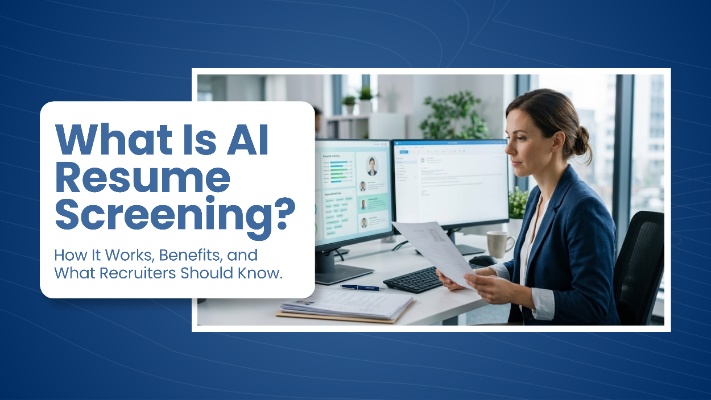
TL;DR: AI resume screening software enables the automated process of reading and ranking candidates’ resumes in accordance with a job description. It speeds up the work of recruiters dealing with numerous applications. Human assessment is still necessary to make the right hiring decision, though.
What is AI resume screening? It is an automated tool that uses artificial intelligence to determine how much an individual’s application for a specific job position corresponds to that particular job description. The difference is that, unlike asking a recruitment officer to go through all the applications line by line to find a match, the software is able to do all that through its algorithmic process.
It's now possible for modern systems to do more than simply match keywords. Using natural language processing and machine learning, it is possible to analyze context, synonyms, and the importance of the candidate’s background for a position.
One can imagine an initial review system. It’s fast, reliable, and never tires even after processing hundreds of CVs. That's why more and more recruiting companies pay attention to it.
The process might seem to be very complex. But basically, it isn’t.
First, the system reads the candidate's resume and extracts useful information. This process is called resume parsing.
It can identify details such as:
These pieces of information are then organized in such a way that the recruitment system understands them. The step of resume parsing is very significant since some resumes might not be readable enough to be properly understood.
Next, the software looks at the job description.
It identifies the important requirements — for example, a company hiring a Digital Marketing Specialist may need SEO, Google Ads, content marketing, analytics, and a certain level of experience. The system uses these requirements as a reference when reviewing applications.
This is where things get more interesting.
Older applicant tracking systems often depended heavily on exact keywords. AI-based recruitment systems that exist today will also take into account the context of the application as well as the relationship between the words used to describe the experience in question.
For instance, the job candidate may refer to his experience as that of a "frontend developer," whereas a position offered may say "UI developer."
Following the analysis of applications, the computer system is now able to score the applicants based on the criteria set for the role. A recruiter may find it easier to get the best matches first without having to go through hundreds of resumes one at a time.
However, scoring highest doesn’t guarantee you the job position. It simply helps move relevant applications closer to human review.
AI screening and an applicant tracking system (ATS) aren't necessarily two completely separate things. In many hiring environments, AI capabilities are added to existing recruitment systems.
Here's a simple comparison:
Feature | Traditional ATS Screening | AI-Powered Screening |
Main approach | Rules and keyword matching | Context, skills, and semantic matching |
Resume review | Automated filtering | Automated analysis and ranking |
Synonyms | May miss related terms | Can often understand related concepts |
Candidate ranking | Based on defined filters | Can use multiple job-fit signals |
Recruiter involvement | Needed for final review | Still needed for final judgment |
Main advantage | Organizes applications | Helps prioritize relevant candidates |
However, it is important to note that each “AI resume screening” solution available does not work in quite the same manner. While some systems continue using keywords and rules primarily, other programs are incorporating more analysis.
For recruiters wondering how to shortlist CVs faster, AI resume screening can simplify the initial screening process by quickly identifying candidates whose skills, experience, and qualifications match the job requirements.
Some common advantages include:
As mentioned by Indeed, AI screening helps employers to identify prospective candidates, and other recruiting platforms discuss its advantages in processing large numbers of applications.
However, time efficiency is not the sole advantage. The importance of consistency cannot be underestimated as well. In case recruiters need to examine hundreds of resumes, fatigue can distract them.
Yes. And this part shouldn't be ignored.
AI screening isn't a perfect replacement for recruiters. There may be mistakes in the data, such as misunderstandings, false positives, and missing out on candidates. This raises an issue of bias when an automated system is designed using data for hiring that is inherently biased. Automated systems learn from historical hiring data that may already contain biased patterns.
There could also be issues because of formatting. If important information isn't parsed correctly, the system may not properly recognize a candidate's experience. This is why it is still important for hiring to involve human decision-making.
Here's how you do it simply: let tech do the repetitive tasks, and then it's up to the recruiter to assess the candidates.
It depends, of course, on the specifics of the recruitment program used and the company’s expectations, but some of the usual red flags may be the following:
The key term in this context is relevance.
Firstly, having a huge number of keywords in a resume does not necessarily mean that the document gets stronger because, instead, using many irrelevant terms in a CV may render it worthless both for the recruitment team and the recruitment system itself.
There is no need for an applicant to compose his CV for robots; he needs to make his own experience comprehensible.
Some simple tips will be useful here:
And don't forget the human reader. After all, the CV might eventually be placed in front of the recruiter’s eyes.
No, it doesn’t.
In fact, the change that has occurred is how AI changes the way recruiters allocate their work time.
Rather than spending a great deal of time on the preliminary resume screening process, recruiters could automate the organization of all applications received. Then they can dedicate that saved time to conducting interviews and evaluating candidates. That distinction matters. It just helps with hiring; the candidate remains far more than a mere number on the dashboard.
AI Resume Screening – What Does It Mean? It implies an advanced and improved approach to the very initial step of the recruiting process, as it uses AI algorithms to analyze applicants' resumes, select required qualifications, compare candidates with the vacancy, etc.
Such a method allows optimizing the process and making it more structured, particularly under the condition of many applications. However, it needs to be applied jointly with human analysis and reasonable employment strategies.
When you want to simplify the process of employing people for your business, we suggest you use Search O Pal's solution called CV Shortlister as well as Candidate Scoring powered by AI algorithms.
I create engaging & informative content around jobs, hiring trends & career development. Through my writing, I aim to help job seekers make smarter career choices & help employers find the right talent in Pakistan.
Previous Post
Create a job-winning resume in minutes with our AI-powered builder.

Comments
No Comments to read