


Search O Pal
Sep 24, 20260 comments10 minutes read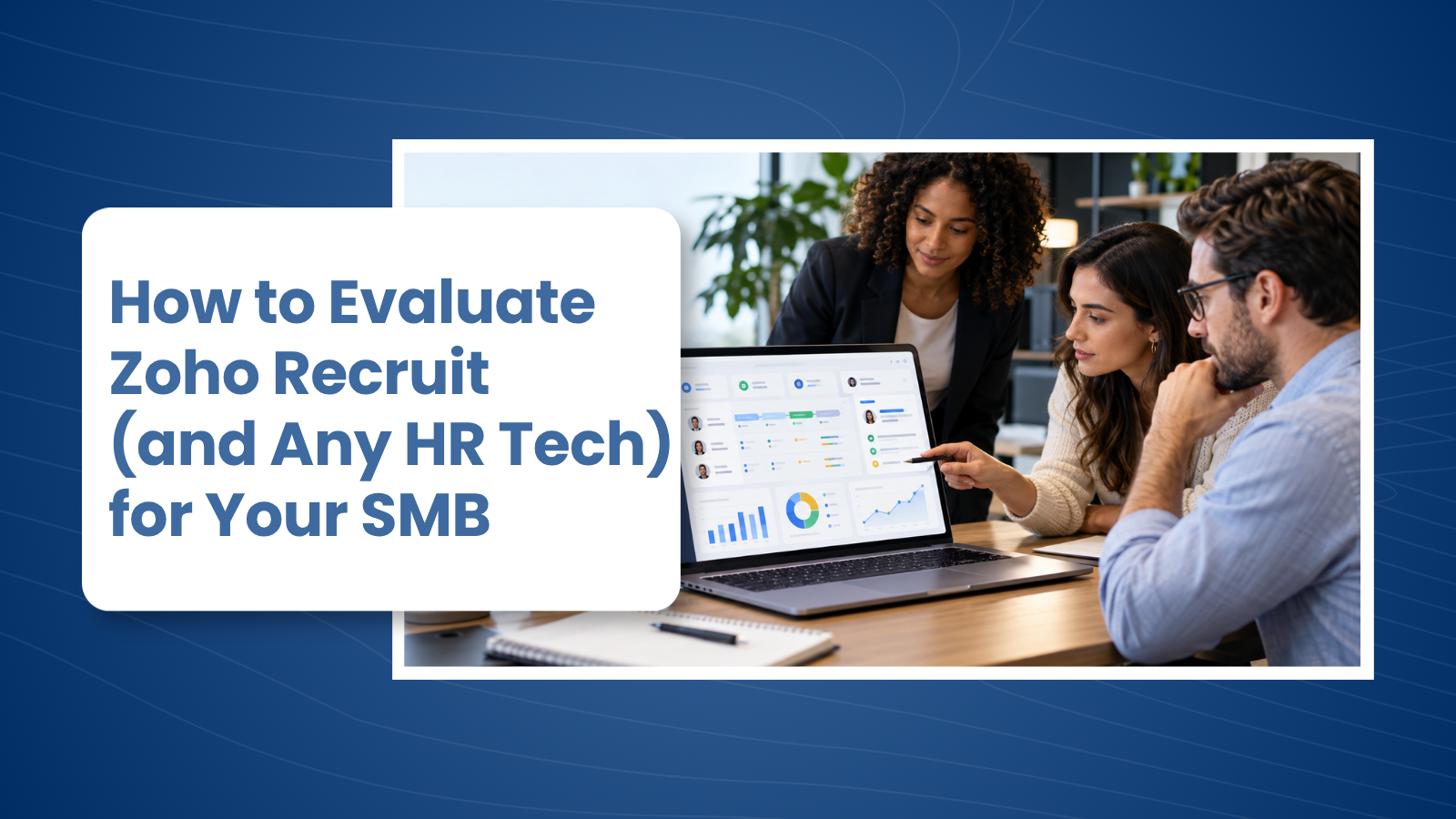
Evaluating Zoho Recruit, or any HR technology platform, for a small or growing business comes down to one key question: does this tool address a real issue in your hiring process, or does it just add another login to your routine? Zoho Recruit is a solid applicant tracking system, especially for teams already using other Zoho tools.
The real challenge is finding out whether its capabilities match your hiring volume, team size, and the specific part of the hiring process that's holding you back. This guide offers a practical way to assess Zoho Recruit, or any HR platform, based on your real needs, not a list of alternative tools. It's a method for judging whether a platform like Zoho Recruit fits what your business truly needs right now.
Many small businesses make the same mistake when looking at HR tech. They look at a pricing page, scan through features, and try to evaluate a tool without considering their unique situation. That approach rarely works because the same tool can be perfect for one company and completely unsuitable for another with a similar number of employees.
Before comparing any software, answer these three questions about your hiring process.
A company hiring three people annually has a different challenge than one hiring thirty. The volume of hiring changes how effective "good" HR tech can be.
For some teams, the issue is the source of candidates — not enough applications. For others, the problem is too many applications and no fast way to identify suitable candidates. Zoho Recruit and similar platforms are built to manage the full hiring pipeline, but if your specific challenge is narrower, a full ATS might be more tool than needed.
A platform that works well for a full-time recruiter can feel overwhelming for a founder or office manager who handles hiring along with other responsibilities.
Zoho Recruit tends to work well under certain conditions. If your company already uses other Zoho products, like Zoho CRM or Zoho People, the integration between them can save time and help reduce the number of separate systems your team has to manage.It also offers a wide range of features, including job posting, candidate pipelines, interview scheduling, and reporting — which is good for companies that want one platform to handle all their hiring activities instead of using multiple tools.
For a company with a dedicated HR or recruiting function, even a small one, the structure and flexibility of a platform like Zoho Recruit can be worth the learning curve, as this structure becomes more valuable as hiring volume increases.
The honest counterpoint is that a fully featured ATS isn't automatically the right choice just because it's well-built. There are some patterns to watch for.
Platforms designed for complex, high-volume hiring often come with setup processes and ongoing configuration burdens that can be too much for a company filling only a few roles a year.
Per-user pricing, add-ons, and job board integrations can turn a reasonable base price into a much higher real cost as your team and hiring volume grow.It’s important to map this out honestly before committing, not realizing the full cost three months later.
Managing a candidate pipeline and identifying the best candidates from a large set of resumes are two different challenges. Some SMBs adopt a full ATS expecting it to fix slow, manual resume screening, only to find that the screening process still depends heavily on someone reading through applications one by one.
Whether you're evaluating Zoho Recruit specifically or comparing several HR tech platforms, the same core questions apply.
The key is to understand how quickly a job can be posted and how fast candidates start applying. A good indicator is whether your team can have a live job posting up and running within two to three days, rather than waiting weeks.
List out the number of users you expect, the roles you plan to fill each year, and the essential integrations you need. Then ask each vendor to provide a quote based on that exact list, not just a generic starting price.
If the vendor promotes AI-powered screening or ranking, request to see a real example of a ranked list for a sample job. Ask them to explain what criteria are used for the ranking. Vague responses are a sign that you should ask more questions.
For small teams without dedicated IT or HR support, how quickly a vendor responds when something goes wrong is just as important as the features they offer.
A platform might look great on paper but could still be unused if it doesn’t align with how your team actually communicates, schedules, and makes decisions on a daily basis.
Not every small business needs a single large platform to manage hiring. For many small teams and recruitment agencies, the real issue is not the entire hiring process, but rather the overwhelming number of resumes and limited time to review them thoroughly.
This is the gap tools like CV Shortlister are built for. Rather than replacing your entire hiring workflow, it focuses specifically on the screening step, taking a job description and a batch of resumes and returning a ranked shortlist based on how closely each candidate matches the actual requirements of the role. For companies that already have a lightweight process for posting jobs and tracking candidates but are losing hours to manual resume review, adding a focused AI screening layer can solve the real bottleneck without the cost or setup time of a full platform switch.
It can be, particularly if your company already uses other Zoho products. For a very small team without a dedicated recruiter, though, the setup and configuration time may outweigh the benefit compared to a lighter-weight tool focused on just the parts of hiring you are actually struggling with.
An ATS manages the full hiring workflow, job postings, candidate pipelines, interview scheduling, and reporting. A screening tool focuses specifically on comparing resumes against a job description and ranking candidates by fit. Some SMBs need both, while others only need the screening piece solved.
If you are struggling to get enough qualified applicants in the first place, that is a sourcing problem. If applications are coming in but reviewing them takes too long, or good candidates are getting missed in the pile, that is a screening problem, and the right tool depends on which one you actually have.
There is no universal answer, but a reasonable rule of thumb is to solve the specific bottleneck you have today rather than the one you might have in two years. A company filling a handful of roles a year with a manageable applicant volume often gets more value from a focused tool than from adopting the overhead of a full platform early.
Zoho Recruit, like most established HR tech platforms, is a solid tool for the right company. The evaluation that actually matters is not whether the software is good in general, but whether it matches your specific hiring volume, your team's workflow, and the exact bottleneck slowing you down right now. For some SMBs, that means a full ATS is worth the setup time. For others, the real fix is narrower: a focused way to screen and rank the resumes that are already coming in, without taking on an entire new system to get there.
Search O Pal is an AI-powered job portal in Pakistan that connects job seekers with verified employers and helps them find relevant jobs quickly and securely.
Previous Post
Create a job-winning resume in minutes with our AI-powered builder.
Comments
No Comments to read